What causes back pain & sciatica?
Some mornings you can barely get your socks on. Other days it is fine until you sit through a long meeting, and then the ache runs into your hip and down the back of your leg. Back pain rarely has a single villain. Your spine is a system of discs, joints, nerves and muscles that share load together, and when one part stops carrying its share, another takes the hit. Finding which part is the purpose of an evaluation.

A spinal disc has a firm outer ring and a softer, gel-like center. When that center pushes through the ring, it can sit against a nerve root and press on it. That pressure is what sends pain, numbness or weakness away from your back and into the hip and leg. Most people notice it most when they bend forward, sit for a long stretch, or cough. Discs respond to graded movement and loading, and surgery is rarely where this needs to start.
Sciatica is a symptom, not a diagnosis. It is what you feel when the nerve running from your lower spine down through the leg gets pinched or irritated: sharp, shooting pain, tingling or numbness that can travel past the knee and into the foot. What is compressing it matters. Nerve gliding work, targeted mobility and hands-on treatment relieve the pressure, but only once the evaluation shows where the pressure is coming from.
The small facet joints link one vertebra to the next and guide how your spine bends and twists. When they stiffen or become inflamed, the pain is usually local, low and one-sided, and twisting or bending makes it obvious. You feel it as a spine that will not turn. Restoring motion in those joints, then correcting the posture that keeps loading them, is what settles them down.
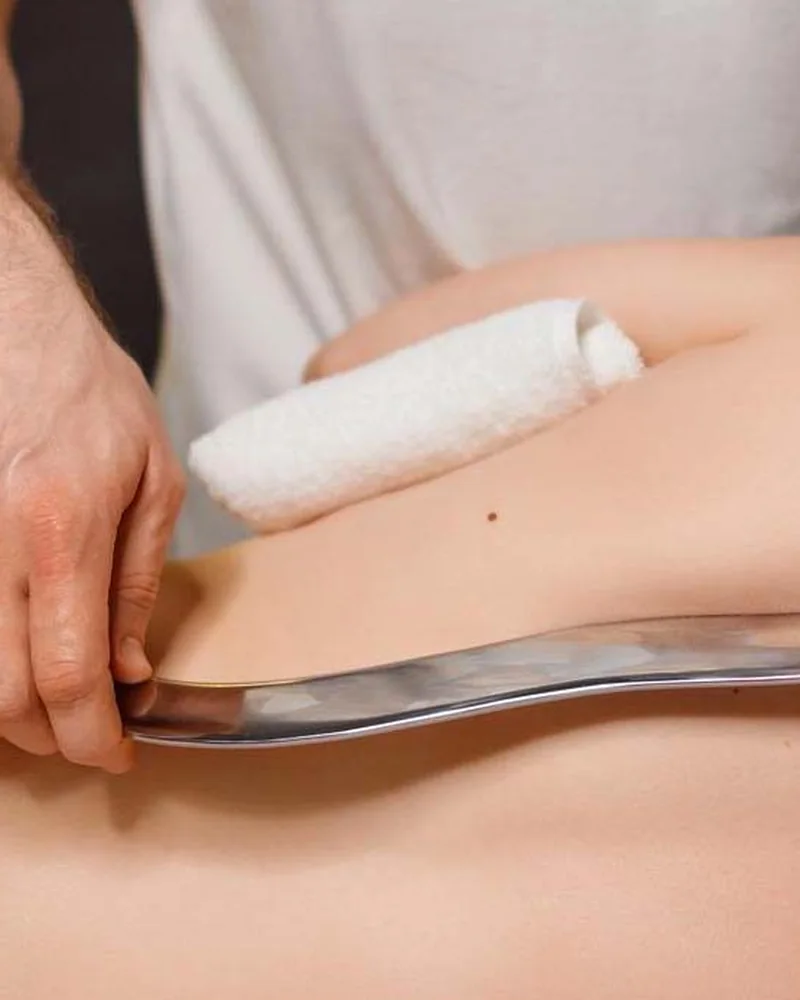
Trigger points are tight, spasming bands inside a muscle. They ache where they sit and refer pain outward, so a knot beside your spine can feel like a band of pain across the whole low back or into the hip. They build in muscles that have been working overtime to protect something else. Hands-on release and mobility work quiet them down, and strength work removes the reason they formed.
Symptoms usually flare around specific habits. Sitting too long loads the discs and lets the muscles that support your spine switch off. Bending from the back instead of the hips stresses the exact tissue that is already irritated. Carrying something heavy on one side asks your spine to stabilize sideways while it is already under load. None of these are moral failings. They are patterns, and patterns can be retrained.
Your spine is built to be supported by the muscles around it. When the deep trunk and hip muscles are weak or slow to switch on, the joints and discs absorb force that was never theirs to absorb. That is why core strengthening shows up in almost every back plan that actually holds. It is not about a flat stomach. It is about the low back not being the only thing holding you up.