Aureum Physio

Dry Needling in Cary

Trigger-point dry needling for the muscle that has not let go, no matter how long you have stretched it, rolled it, or waited it out.

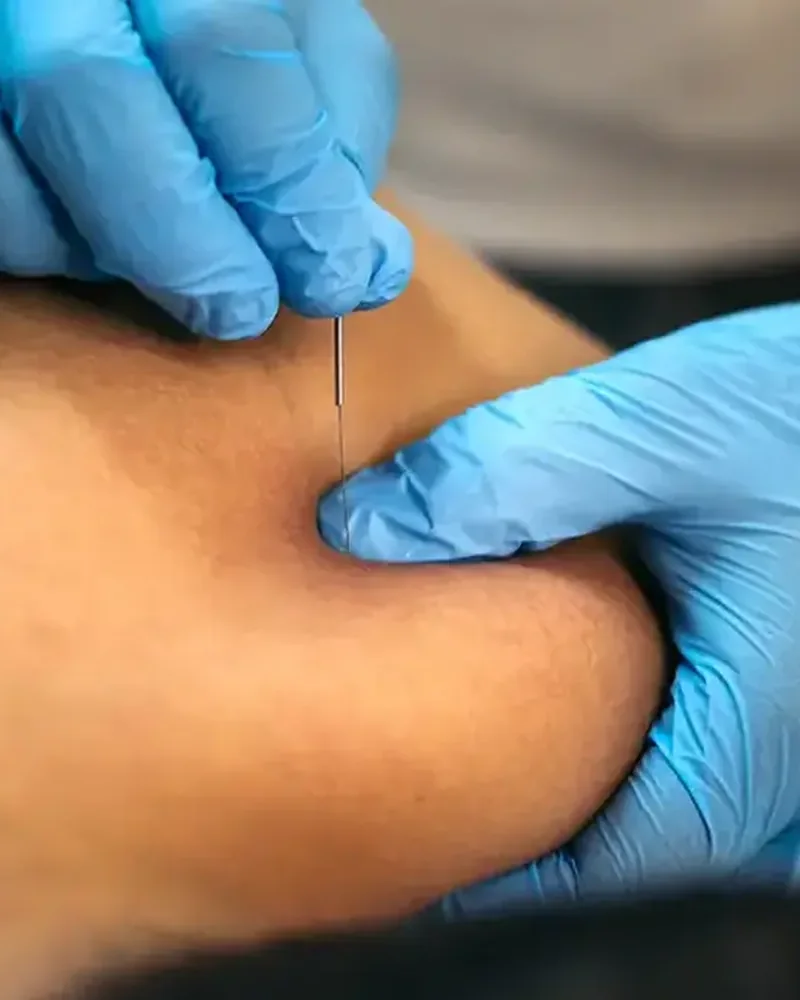
Gloved hands inserting a fine needle into a muscle trigger point
01What It Is

What Is Dry Needling?

You can put a finger on it. The same spot every time, and it has been there long enough that you have stopped bringing it up. You have stretched it, rolled it, had someone dig into it, and it is back by the end of the week. Dry needling reaches that spot directly. A thin, solid needle, with no medication in it, goes into the taut band of muscle and the tender trigger point inside it. The muscle answers with a quick involuntary twitch, and that twitch is the point: a local reflex that lets the band let go, brings blood flow back to starved tissue, and turns down a pain signal that has been switched on far too long. It is not acupuncture. Acupuncture comes from traditional Chinese medicine and works with meridians and energy flow. Dry needling comes from modern anatomy and pain science, and every needle goes into a named muscle for a specific mechanical reason.

The needle is one tool, not the plan. What it buys you is a window where the muscle is quieter and the joint moves further than it has in months. Hands-on treatment and corrective exercise inside that same window are what make the change stay, which is why needling alone tends to wear off and needling followed by loading tends to hold. Your session runs 40 minutes, one on one with your Doctor of Physical Therapy, even though the needling itself is a few minutes of it. North Carolina has unrestricted direct access to physical therapy, so no physician referral is needed to be evaluated or treated here. Aureum Physio accepts most major insurance plans and verifies your coverage before treatment begins, so you know your costs up front. Most patients come 2 to 3 times a week for 4 to 6 weeks, and many notice a change in the first week or two.
02Who It's For

Who It's For

Dry needling is not for every kind of pain, and it is not a plan by itself. It earns its place when the problem is muscular, findable by hand, and stubborn.

01

One tender spot you can point to

Chronic tightness with a trigger point sitting at the middle of it, in the shoulder blade, the hip, the calf. It refers pain out to somewhere else and it caps your range. Needling the band lets the muscle lengthen again. The outcome: the range you get back is range you can then train, instead of losing it by Thursday.

02

Tension headaches, jaw and neck pain

Tension headaches, migraine patterns, TMJ trouble, or a neck that never settled after whiplash often trace back to trigger points in a few small muscles you cannot stretch on purpose. Treating those directly is more precise than working the whole region. The outcome: fewer days that begin with your hand on your neck.

03

Tendon and repetitive-strain pain that has stalled

Plantar fasciitis, a tendon that flares every time you build mileage back up, repetitive strain from your job rather than your sport, or post-surgical scar tissue that will not glide. Needling reduces the guarding around it. The outcome: you tolerate the progressive loading that actually rebuilds a tendon.

03What To Expect

What to Expect

It is a short procedure inside a normal session, and none of it should be a surprise. Here is the sequence.

01

Screening, then consent

Before any needle, your physical therapist takes your history, asks about the medications and conditions that decide whether needling is appropriate, and finds the trigger point by hand so you both know the target. They describe the sensation, and you agree to it. If needling is not right for you, they say so and treat the problem another way.

02

The needle, and the twitch

A thin needle passes through the skin into the taut band. Most people barely register the skin, then feel a deep, dull ache and a brief involuntary twitch as the band releases. It reads as a strange sensation more than a painful one. The needle stays in for seconds up to a couple of minutes, then comes straight out.

03

Move it, then keep it

You get up and move right away, because a quieter muscle is only worth something if you use the range it gave back. Expect mild soreness, much like the day after a hard workout, usually gone within a day or two. Heat, water and easy movement help. You leave with exercises that hold the change.

Safety and who it is not for

Dry needling is not appropriate for everyone, and deciding that is a conversation, not a checkbox. Tell us before your appointment if you are pregnant, take a blood thinner or have a bleeding disorder, have a weakened immune system, are on the affected side after lymph node removal or have lymphedema, or have any infection, open wound, rash or healing incision over the area. Needling is not done through compromised skin, and not over an implanted device or a joint replacement. A genuine needle phobia or a history of fainting with injections is also a reason to choose a different technique, and there is always a different technique. Some of these rule needling out entirely, most simply change where and how it is done that day. On sensation: expect a deep ache and a quick muscle twitch rather than a sharp sting, and a day or two of soreness afterward. Serious complications are uncommon but real, and around the ribcage and shoulder blade depth and angle matter a great deal, which is why the technique belongs only in trained hands. Our physical therapists are trained in trigger-point dry needling, and if it is not the right tool for your problem we will tell you.

In Their Words
Awesome place for physical therapy. Heather listens, comes up with attainable realistic goals, pushes when needed, and makes physical therapy as fun as possible!
Jesse W. · Google review
Explore More

Where to go next.

Request an Appointment

Ready when you are.

HoursMon & Wed: 11:00am - 7:00pm | Tue & Thu: 7:40am - 5:00pm | Fri: 7:40am - 2:00pm | Sat-Sun: Closed
Walk-insCall ahead
Book your evaluation. No referral needed in North Carolina.
Step 1 of 5
First things first. What's your name?
We'll need a name to book you in.
Best number to reach you?
A phone number lets us confirm same-day.
And your email?
We'll send your confirmation here.
What questions do you have about your pain or injury?
A few words is all we need.
Look right? Send it.
✓
Request received.

We'll call within business hours to lock in your time.

Book Now · No Referral Needed