Rehab got you out of pain. Out of pain is not the same as strong. This is the training that closes the gap, coached by the same doctor of physical therapy who treated you.

You were discharged from therapy a while ago. The pain is gone, you were told you were fine, and you still catch yourself hesitating before you pick up something heavy or push the pace on a run. That hesitation is not in your head. Finishing rehab pain free and getting your pre-injury strength, endurance and capacity back are two different finish lines, and most people only ever cross the first one. Functional fitness is the training that covers the distance between them. It starts from a clinical look at how you actually move, then loads you on purpose: real-world strength, balance and mobility that show up in your sport, on the job, and in the ordinary lifting and carrying that fills a week. Your Doctor of Physical Therapy builds and coaches the sessions personally, so the person deciding what you load next is the person who already knows what your injury did to you and what your tissue tolerated last month. Care here moves through four phases: Pain, Prime, Perform, Prevent. Functional fitness is the back half of that arc, the Perform and Prevent work that most people never reach because their care ended the day their symptoms did.
It is a fair place to start even if you were never injured. Plenty of people simply want to lift, run and move well without guessing at their own programming or inheriting a plan written for somebody else's body. The advantage of training inside a clinic is the assessment underneath it. A doctor of physical therapy sees the shoulder that shrugs early, the hip that gives out on one side, the ankle that never got its motion back, and writes around those findings instead of loading straight through them. When something does flare, it gets looked at in that session rather than filed away until it becomes an injury.

Functional fitness is for anyone who wants to be measurably stronger and does not want to buy a new injury on the way there. Three situations come up most often.
Your therapy goals were met and you still do not feel like yourself. The strength, the wind and the confidence never fully came back, and nothing since has been structured enough to bring them back. Outcome: you leave with the capacity you had before the injury, not just the absence of pain.
Treatment is over, the season is coming, and going straight back to full training feels like a gamble. This is the bridge between being released from care and being genuinely ready to compete. Outcome: you return to your sport loaded and tested, instead of hoping the first hard week goes well.
No injury, no rehab, just a wish to lift and move well without inventing your own program or copying somebody else's. Your training gets written from an actual movement assessment. Outcome: steady, progressive gains, with the weak links addressed before they turn into a reason to stop.
Every session is 40 minutes, in person and one on one with your Doctor of Physical Therapy. Nobody hands you a printed sheet and walks away, and you are never sharing the session with two other people.
The first visit is spent finding out what your body can currently do and what you want it to do. Your physical therapist screens strength, balance and mobility side to side, asks what you were able to do before, and turns that into a specific target rather than a vague plan to get in shape.
Most people train 2 to 3 times a week for 4 to 6 weeks to build a base, and many notice a difference in the first week or two. You are coached through each lift and each drill, and the load only goes up when your movement has earned it, not because the calendar says week three.
The same measures from day one get repeated so progress is a number, not a feeling. Then the program becomes yours to run. You leave knowing what to keep doing, what to progress and what to watch, which is the Prevent half of the work.
Training is offered as in-person, one-on-one session packages. If your schedule genuinely will not allow that, ask about a written program you can run at your own pace instead. Call the clinic for current pricing. And if what you actually need turns out to be treatment rather than training, say so when you call: North Carolina has unrestricted direct access to physical therapy, so you can be evaluated here without a physician referral, and Aureum Physio accepts most major insurance plans and verifies your coverage before treatment begins so you know your costs up front.
Heather has been a great physical therapist for helping me address my day-to-day issues.

If the injury itself is still the problem, start there. Sports rehab is the treatment phase that hands you off to this training.

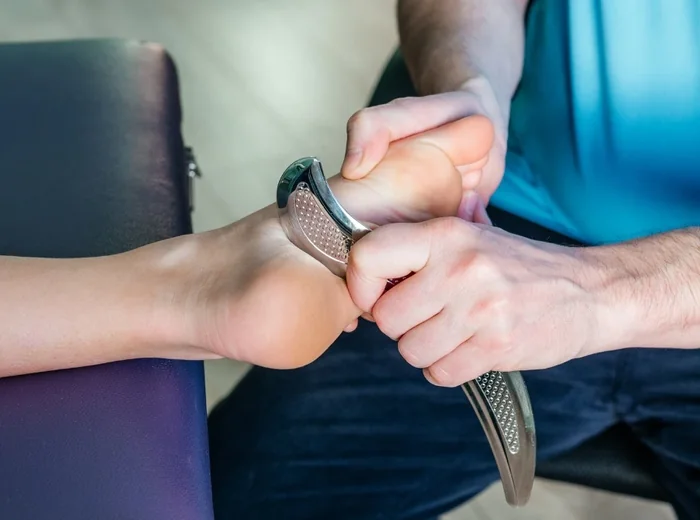
Training only progresses if you recover between sessions. Dedicated soft tissue work keeps soreness from deciding what you can train this week.

Still in pain? Training is the wrong first step. An evaluation comes first, and treatment is where it ends up.