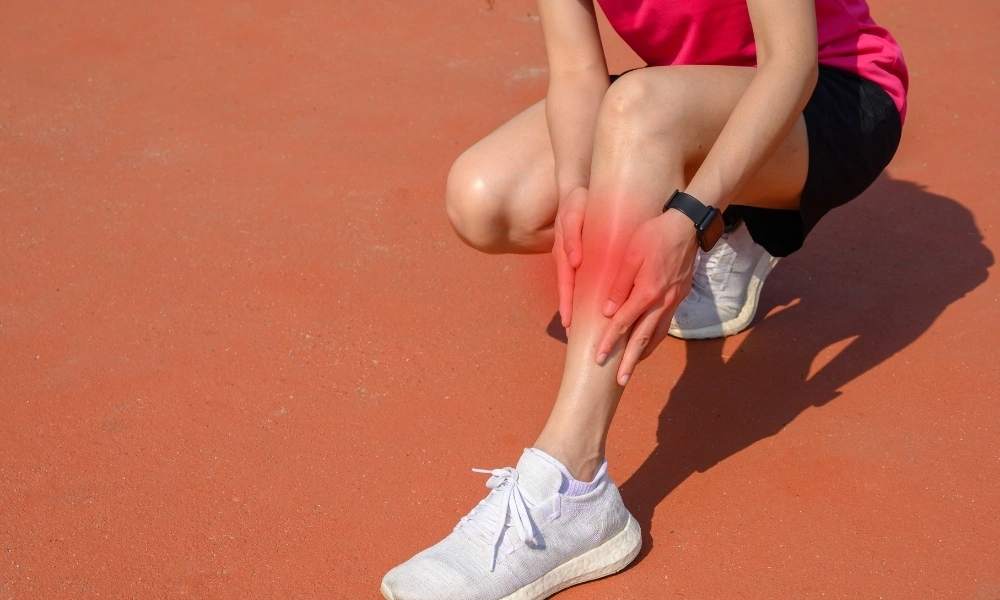
Medial Tibial Stress Syndrome is an overuse injury of the lower leg that causes pain along the inner border of the tibia (shin bone).
Runners typically feel:
- Aching or sharp pain along the inside of the shin
- Pain that starts during or after running
- Tenderness along a long section of the shin bone
- Symptoms that worsen with increased mileage or intensity
The discomfort usually develops gradually and often affects the lower two-thirds of the shin bone.
While runners often think shin splints are just inflammation, the condition is actually more complex.
Why Shin Splints Happen
MTSS develops when repetitive stress on the shin exceeds the body’s ability to recover.
Several mechanical factors can contribute.
1. Excessive Foot Pronation
During running, your foot naturally rolls inward slightly to absorb shock.
However, excessive inward movement (pronation) can increase traction forces along the tibia, contributing to irritation and pain.
2. Weak Foot and Lower Leg Muscles
One muscle that plays a surprisingly important role is the flexor hallucis longus (FHL) - the muscle that helps flex the big toe.
This muscle helps:
- Stabilize the arch of the foot
- Control loading during push-off in running
- Support efficient force transfer through the lower leg
Runners with MTSS often show reduced strength or size of this muscle, which can increase stress along the tibia during running.
3. Sudden Training Changes
Common triggers include:
- Rapid increases in mileage
- Increasing speed workouts or hills
- Switching shoes or surfaces
- Returning to running after time off
These changes can overload the tibia and surrounding tissues before they have time to adapt.
How Physical Therapy Helps Shin Splints
Simply resting from running may temporarily reduce pain, but it doesn’t fix the underlying cause. Physical therapy focuses on addressing the mechanics that created the injury in the first place.
1. Identifying the Cause of Tibial Stress
At Aureum Physio, we evaluate key factors such as:
- Running mechanics
- Foot loading patterns
- Strength of foot and lower-leg muscles
- Mobility and alignment of the lower limb
This helps identify why the shin is being overloaded during running.
2. Strengthening the Foot and Lower Leg
Rehabilitation often includes exercises that strengthen:
- The intrinsic foot muscles
- The flexor hallucis longus (big toe flexor)
- The calf complex
- The posterior chain
These muscles help absorb impact and stabilize the arch, reducing stress on the tibia.
3. Improving Running Mechanics
Small changes in running form can significantly reduce stress on the shin.
At Aureum Physio, we have trained extensively in running gait analysis and running gait re-training. Physical therapy may focus on:
Optimizing stride mechanics
- Improving shock absorption
- Reducing excessive pronation
- Improving lower-limb control
These changes allow runners to return to training while minimizing reinjury risk.
4. Progressive Return to Running
Instead of simply waiting until pain disappears, physical therapy uses structured return-to-run progressions to safely rebuild tolerance.
This approach ensures the tibia and surrounding tissues adapt gradually to training loads again.
The Bottom Line for Runners
Shin splints are not just a minor annoyance - they are a sign that the load on your shin is exceeding what your body can handle.
The most effective treatment approach focuses on:
Correcting biomechanical stress
- Strengthening foot and lower-leg muscles
- Improving running mechanics
- Gradually restoring training load
When addressed properly, runners can often return stronger, more efficient, and less prone to future injuries.
When to See a Physical Therapist
If you notice:
- Persistent shin pain while running
- Pain that returns quickly after rest
- Increasing tenderness along the shin
It may be time for a professional evaluation to prevent the injury from progressing to a stress fracture.
Work With Aureum Physio
At Aureum Physio, we specialize in one-on-one physical therapy for runners and active individuals.
Our approach combines:
- Movement analysis
- Strength and load management strategies
- Evidence-based rehabilitation to help runners recover from injuries and perform at their best.
Learn more or schedule an appointment: