What causes foot and ankle pain?
You feel it on the first step in the morning, on the stairs, or somewhere in the second mile. Your feet and ankles absorb thousands of steps a day and carry the whole weight of you every time. Wear over the years, a twist that never fully healed, or an arch that stopped absorbing shock all end in the same place: pain that arrives with the one thing you cannot stop doing, which is walking.
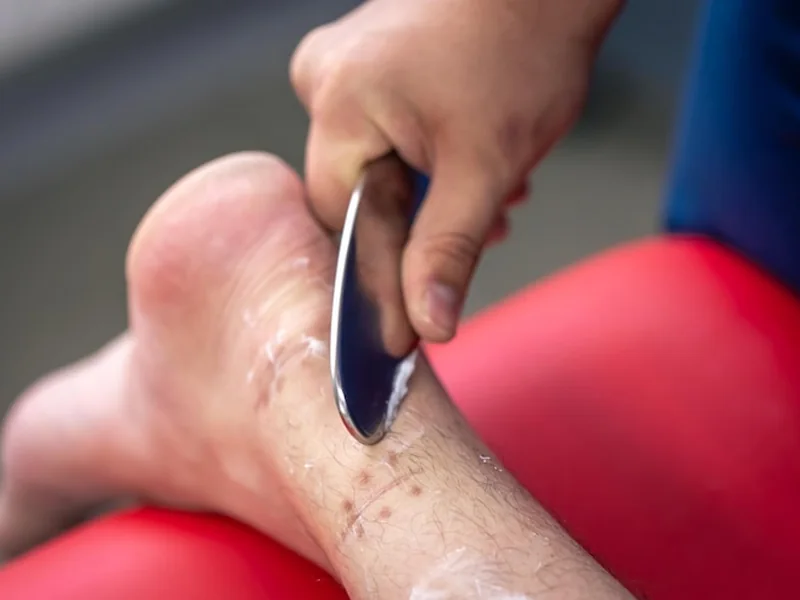
A twist or a misstep can tear the ligaments that stabilize your ankle. The swelling goes down in a couple of weeks and the limp goes away, so most people stop there. What does not come back on its own is the strength and the sense of where your foot is in space. That is why an ankle sprained years ago still rolls on uneven ground, swells after a long day, or gives out without warning.
The plantar fascia runs along the sole of your foot from the heel to the base of the toes. Held under constant tension, it becomes irritated and sends a sharp, stabbing pain through the heel and arch, worst with the first steps of the morning or after you have been sitting. It is usually a combination problem: calf tightness, arch control, and how many hours a day you spend standing.
The Achilles connects your calf to your heel and takes the force of every step, hill and jump. When it is asked to do more than it has been conditioned for, or when a tight, inflexible calf keeps it under tension, it becomes painful at the back of the heel or just above it. Tendons do not respond to rest alone. They respond to the right load, applied in the right order.
A high arch and a flat arch both change how force travels up your leg. When the arch is too rigid or too collapsed to absorb the impact of a step, the joints and tissues above it compensate, and the pain shows up in the arch, the heel, or along the outside edge of the foot. Improving foot stability and arch control changes what the whole lower leg has to handle.
Running, jumping, or a sudden increase in time on your feet strains tendons and ligaments faster than they can adapt. Add a new pair of shoes with different support, or a harder surface than you are used to, and the tissue gets a change it was not conditioned for. Feet are adaptable. They just need the change to arrive gradually, with the strength behind it.
Years of weight-bearing activity wear down cartilage, form bone spurs, and slowly restrict how far the foot and ankle will move. Less motion means the joint has fewer ways to share load, so the same steps cost more. Stiffness of this kind is not a dead end. Restoring the movement that is still available, and strengthening what surrounds the joint, is what makes walking comfortable again.