

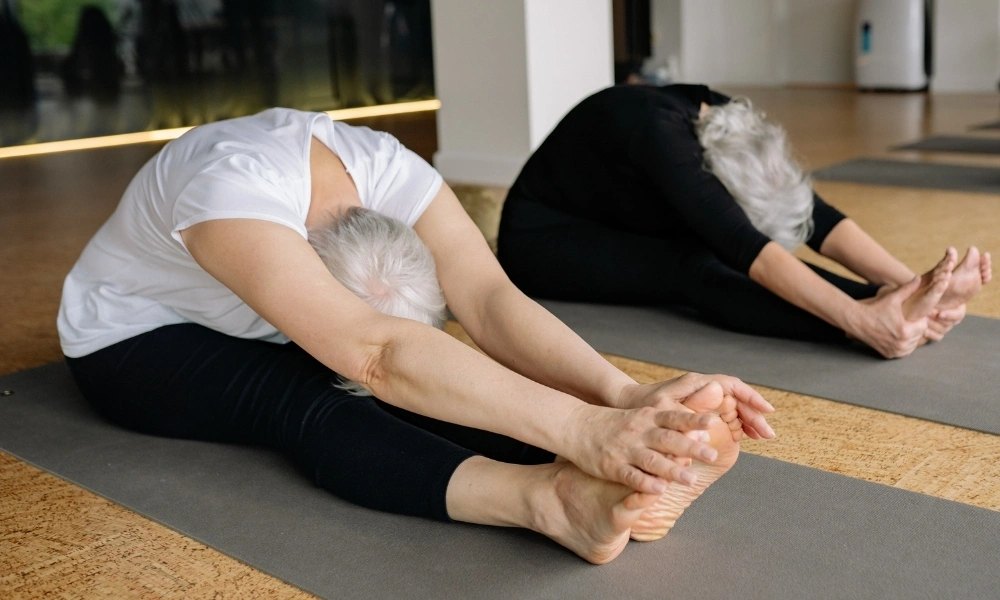
If you’ve ever felt like your hips are tight after sitting all day or after a long run, your first instinct may be to stretch your hip flexors.
While stretching can help improve flexibility, research shows that stretching alone does not necessarily improve how your hips actually move during activity.
In fact, one study examining runners with limited hip extension found that increased flexibility did not translate to improved running mechanics.
This highlights an important concept in physical therapy and performance training:
Mobility requires strength and control—not just flexibility.
A study published in the Journal of Strength and Conditioning Research evaluated runners with limited hip extension who completed a 3-week hip flexor stretching program.
Participants performed daily stretching exercises including standing hip flexor stretches and kneeling lunges.
Researchers measured:
- Passive hip extension (flexibility)
- Hip motion during running
- Pelvic tilt
- Lumbar spine movement
The results were interesting.
Stretching significantly improved passive hip flexibility.
However, despite improved flexibility:
- Active hip extension during running did not change
- Pelvic tilt did not change
- Lumbar spine motion did not change
In other words:
The runners became more flexible, but their running mechanics stayed the same.
Why Stretching Alone Doesn’t Change Movement
Flexibility describes how far a joint can move passively.
But athletic movements like running rely on active mobility, which depends on several other factors:
- Muscle strength
- Neuromuscular coordination
- Motor control
- Joint mechanics
- movement patterns
Even if flexibility improves, the body may continue using the same movement strategy it has practiced for years.
Without strength and control, new ranges of motion often never get used during movement.
Why Strength Training Is the Key to Better Hip Mobility
If someone truly wants to improve hip motion, reduce injury risk, or improve running mechanics, stretching alone is rarely enough.
The body needs strength through the available range of motion.
Strength training helps:
- Activate the glutes and posterior chain
- Improve hip extension power
- Stabilize the pelvis and lumbar spine
- Teach the body to use new ranges of motion
This is why physical therapy programs often combine:
✔ mobility work
✔ strength training
✔ movement retraining
rather than focusing on stretching alone.
What This Means for Runners
For runners experiencing tight hips, back discomfort, or limited stride mechanics, the solution is often not just more stretching.
Instead, improving hip mobility typically requires:
- Glute strengthening
- Hip extension strength
- Core stability
- Running mechanics assessment
When these elements are addressed together, runners can improve movement efficiency and reduce injury risk.
How Physical Therapy Can Help
At Aureum Physio in Cary, NC, we take a comprehensive approach to mobility and performance.
Rather than focusing on isolated stretching, we evaluate:
- hip mobility
- strength deficits
- movement mechanics
- running form
Our goal is to help runners move better, feel better, and perform at their highest level.
Interested in improving your running mechanics or hip mobility?
Schedule a running assessment or physical therapy consultation at: